Purgatory is not a
Second Chance and,
What is Grace?
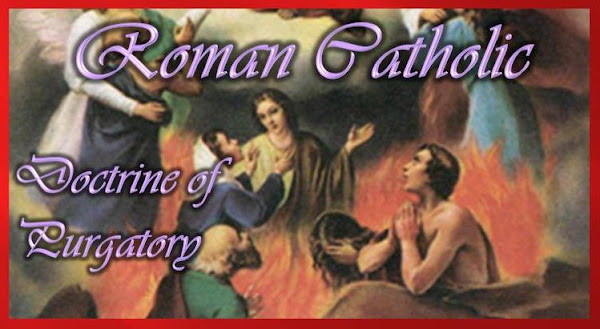
Roman Catholicism does not teach that Purgatory is a second chance at salvation. Purgatory is a place where those who are saved go to suffer temporarily. Those in Purgatory died in the state of grace, but may have some unrepented venial sins or may have to make satisfaction for forgiven mortal sins. There they suffer until admitted into heaven (see Catholic Catechism #1030).
In that case we must ask, what is grace? Can you die in a state of grace and still have to suffer for your own sins? Can you make satisfaction or payment for your own sin?
Hermano Sandoval taught that we cannot know who is going to heaven and who is not because we have not been judged yet, that is, judgement before God after our death.[1] However, John wrote, “I write these things to you who believe in the name of the Son of God so that you may know that you have eternal life.” (1st John 5:13) John did not write so that you may wonder, or worry, or think, or hope. Neither does he write you might have, or may gain, or will be lucky to get, eternal life. No, rather, he writes so that you may know! that you have eternal life! Thank you Jesus.
The Catholic Catechism #1473 states, “the Christian must strive to accept this temporal punishment of sin as a grace. He should strive by works of mercy and charity, as well as by prayer and the various practices of penance, to put off completely the ‘old man’ and to put on the ‘new man.’”
The Catholic Catechism teaches that punishment for sin is a grace, yet we need not debate what grace is and is not, because the Bible clearly defines it for us. Also note that while we are called to do good works, the Bible makes it clear that good works cannot merit salvation. We do good works because we have been saved.
“And if by grace, then it is no longer of works; otherwise grace is no longer grace. But if it is of works, it is no longer grace; otherwise work is no longer work” (Romans 11:6).
“For by grace you have been saved through faith, and that not of yourselves; it is the gift of God, not of works, lest anyone should boast” (Ephesians 2:8-9).
“But when the kindness and love of God our Savior toward man appeared, not by works of righteousness which we have done, but according to His mercy He saved us, through the washing of regeneration and renewing of the Holy Spirit” (Titus 3:5).
“This righteousness from God comes through faith in Jesus Christ to all who believe. There is no difference, for all have sinned and fall short of the glory of God, and are justified freely by his grace through the redemption that came by Christ Jesus. God presented him as a sacrifice of atonement, through faith in his blood…to be just and the one who justifies those who have faith in Jesus” (Romans 3:22-26).
“All of us are like someone unclean, all our righteous deeds are like menstrual rags; we wither, all of us, like leaves; and our misdeeds blow us away like the wind” (Isaiah 64:6).
“‘The righteousness of the righteous man shall not deliver him in the day of his transgression; as for the wickedness of the wicked, he shall not fall because of it in the day he turns from his wickedness; nor shall the righteous be able to live because of his righteousness in the day that he sins.’ When I say to the righteous that he shall surely live, but he trusts in his own righteousness and commits iniquity, none of his righteous works shall be remembered” (Ezekiel 33:12).
“when the kindness and the love of God our Savior toward man appeared, not by works of righteousness which we have done, but according to His mercy He saved us, through the washing of regeneration and renewing of the Holy Spirit (Titus 3:4-5).
“the power of God through faith for salvation ready to be revealed in the last time.” (1st Peter 1:5).
If we are saved by grace then works cannot merit salvation, and if we are saved by works then grace is of no affect, therefore, if grace is then works are not, and if works are then grace is not.
And so we see that if we die in a state of grace we do not and cannot still have to suffer for our own sins. If we could make satisfaction for our own sin, why did Jesus humble Himself from the heights of heaven to the most humiliating death on Earth?
The concept of Purgatory presents us with an example of yes/but theology. Yes Jesus died for our sins but we must still suffer. Yes Jesus paid the price on the cross but we must still suffer. Yes Jesus paid it all once and for all but we must still suffer. According to dogma, Christ’s passion on the cross keeps those who are His our of hell but they must still suffer for their own sin, unrepented venial sin and repented mortal sin.
The most dangerous aspect of the doctrine of Purgatory is that when we draw the concept to its logical conclusion we conclude that Jesus did not pay the entire price for all of our sins on the cross. Roman Catholicism does not teach this but it is the logical conclusion. Of course, the Bible disagrees and makes it plain and simple, “So when Jesus had received the sour wine [or vinegar], He said, ‘It is finished!’ And bowing his head, He gave up His spirit” (John 19:30).
Moments before His death on the cross Jesus cried out “It is finished” or “Paid in full.” The Gospel writers used the Greek word “Tetelestai,” which is the perfect tense of the word “tel-eh'-o” that is used in the New Testament to mean; finish, fulfill, accomplish, pay, perform, expire, to bring to a close, to end, passed, complete, to pay. The word “tel-eh'-o” comes from the word “tel'-os” that is used to mean; end, uttermost, finally, ending, termination, the limit at which a thing ceases to be, the last in any succession or series, that by which a thing is finished, its close. The perfect tense in Greek corresponds to the perfect tense in English, and describes an action which is viewed as having been completed in the past, once and for all, not needing to be repeated.
On the issue of second chances at salvation the fact is that we do get a second change, we get a second, third, fourth, we get hundreds all throughout our lives. These chances only cease when we die and live all of eternity where we have chosen to do so.
[1] Stated during a class held at St. Joseph on the Rio Grande Roman Catholic Church, Alb., NM. on March 20th, 2001