Sunday, November 06, 2005

Purgatory’s Conception
and Chronology


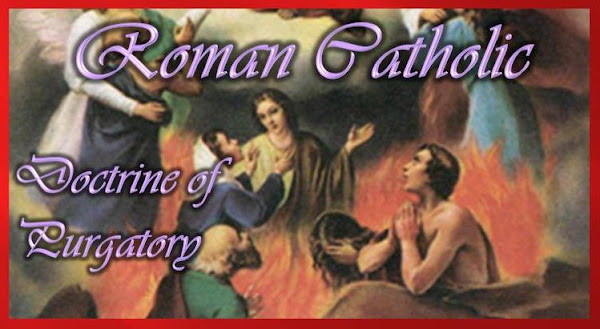
The Roman Catholic dogma of Purgatory is based on faulty reasoning and assumptions, which in turn are apparently based on pagan practices or a Jewish and later Christian corruption of God’s Word.

There are a few major stages in the conception of Purgatory:

The second book of Maccabees is both the starting place as well as the final episode. It is the starting place because it is from chapter 12 that we learn that it is wholesome to pray for the dead. There is an extremely important fact of history regarding Maccabees as well as the other apocryphal books in the Roman Catholic Bible (which are not found in Protestant nor in Jewish Bibles). These books were not considered officially canonical until the Council of Trent 1545-1563 AD (see The Catechism of the Catholic Church #1031). When the printing press was invented people had the Bible translated into their common language (which the Roman Church forbade under the threat of capital punishment). Once people read the Bible for themselves they protested (Protestants) stating that the Roman Church was teaching things that the Bible did not, and that they were not teaching things that the Bible did. Possibly the most extreme incident of isogesis in history took place when the Roman Church took its preconceived notions and literally forced them into the Bible. In order to prove the protesters wrong, they inserted extra books that appeared to say what they were already teaching.

Inscriptions in which Christians pray to the dead have been found in Roman catacombs dating from the second and third century AD. One inscription reads, “Ask for us in thy prayers, for we know thou art with Christ.”
[1] In 211 AD Tertullian wrote, “The faithful wife will pray for the soul of her deceased husband, particularly on the anniversary of his falling asleep. And if she fails to do so, she has repudiated her husband as far as in her lies.”[2] St. Augustine, born Nov. 13, 354 AD, record his dying mother’s words to him, “Put this body away anywhere. Don’t let care about it disturb you. I ask only this of you, that you remember me at the altar of the Lord, wherever you may be.”[3]
“The Apostolic practice of praying for the dead which passed into the liturgy of the Church, is as clear in the fourth century as it is in the twentieth. St. Cyril of Jerusalem (Catechet. Mystog., V, 9, P.G., XXXIII, col. 1116) describing the liturgy, writes: ‘Then we pray for the Holy Fathers and Bishops that are dead; and in short for all those who have departed this life in our communion; believing that the souls of those for whom prayers are offered receive very great relief, while this holy and tremendous victim lies upon the altar.’”[4]

v A letter by Pope Innocent IV (1243-54) states, “In the Gospel, the Truth declares that whoever speaks blasphemy against the Holy Spirit, it will not be forgiven him either in this world or in the world to come (Mt. 12:32). By this it is to be understood that certain faults are pardoned in this life, and certain others in the life to come. Moreover, the Apostle says that ‘the fire will assay the quality of everyone’s work,’ and ‘if his work burns he will lose his reward, but himself will be saved, yet as through fire’ (1 Co. 3:13, 15).”[5] The Catechism of the Catholic Church #1032 states, “From the beginning the Church has honored the memory of the dead and offered prayers in suffrage from them, above all the Eucharist sacrifice, so that, thus purified, they may attain the beatific vision of God [Cf. Council of Lyons II (1274): DS 856].”
Here we see what is perhaps the first instance of the assumption on which Purgatory is based. There appears to have been a long history of praying for the dead. It was reasoned that those in heaven need no prayer and prayer cannot help those in hell. Therefore, a third state of existence after death must exist. From here the dogma of Purgatory was constructed. In reality, a long history of praying for and to the dead is really just a long history of a non-Biblical practice that the Church should have shunned rather than incorporated.


[1] John L. Stoddard, Rebuilding a Lost Faith (New York: P. J. Kenedy and Sons, nd.), p. 181
Nihil Obstat: C. Schut, D.D., Censor Deutatus. Imprimatur: Edm. Can. Surmont, Vicarius Generalis. Westmonasteri, Die 21 Martii, 1922.

[2] Tertullian, The Crown (AD 211), 3, 2, quoted in W.A. Jurgens, ed., The Faith of the Early Fathers (Collegeville, Minn.: Liturgical Press, 1970), p. 151
[3] John K. Ryan, trans., The Confessions of St. Augustine (New York: Image Books Doubleday, 1960), p. 223 (Book 9 ch. 11)
[4] New Advent, The Catholic Encyclopedia, Vol. XII (Copyright © 1911 by Robert Appleton Company Online Edition Copyright © 1999 by Kevin Knight), Edward J. Hanna, Transcribed by William G. Bilton, Ph.D. Nihil Obstat: June 1, 1911. Remy Lafort, S.T.D., Censor. Imprimatur: +John Cardinal Farley, Archbishop of New York, newadvent.org
[5] Innocent IV, letter Sub Catholicae (Mar. 6, 1254)