Sunday, November 06, 2005

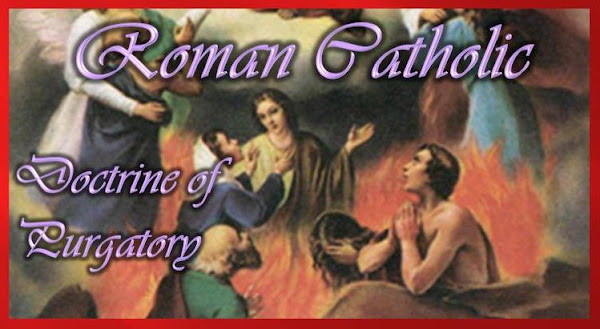
Roman Catholic

Definition of Purgatory

and the Biblical Teaching

Fr. F.X. Schouppe, S.J. wrote, “It is a fact of divine revelation that the soul of every person who dies in the state of grace, but without having made sufficient expiation of earth for his forgiven sins, will undergo the punishment and purification of Purgatory before entering Heaven…its pains are excruciating—greater then any suffering known on earth…they are adapted to the past sins of each individual soul…they can vary in duration from less than one minute to a period of several centuries….if we are not absolutely perfect at the time of our death, but yet not deserving of Hell, we shall all go to Purgatory.”[1]
The full and one time expiation for our sins was accomplished by Jesus, these sort of teachings are a plain and simple denial of this fact. Fr. Schouppe further stated that Purgatory “is a fact of divine revelation” but note that Fr. Schouppe states that for proof of Purgatory “we posses three very distinct sources of light: first, the dogmatic doctrine of the Church; then the doctrine as explained by the doctors of the Church; in the third place, the revelations and apparitions of the saints, which serve to confirm the teachings of the doctors.”[2]

From the New American Bible Fireside Family Edition:[3]
“That place or state of punishment where the souls of those who have died in the state of grace, but who still may have some unrepented venial sins or may have to make satisfaction for forgiven mortal sins, suffer until admitted into heaven. The Church proves the Doctrine of Purgatory. Sacred scripture, in the Old Testament, relates how Judas Maccabeus sent 12,000 drachmas of silver to Jerusalem for sacrifice to be offered for the sins of the dead. Through the inspiration of the Holy Spirit, the writer of the book wrote, ‘It is therefore a holy and wholesome thought to pray for the dead that they may be loosed from their sins.’ Christ Himself inferred there are sins which can be forgiven after death: ‘And whoever speaks a word against the Son of Man will be forgiven.’ That complete satisfaction must be made is noted by Christ, ‘I tell you, on the day of judgement people will render an account for every careless word they speak.’
Holy Scripture also tells us about heaven ‘nothing unclean will enter it, nor any [one] who does abominable things or tells lies.’ Therefore, it is logical to reason that a soul in the state of grace but with venial sin staining it must be cleansed of that venial sin before entering heaven.
In Purgatory the poor souls primarily suffer a pain of loss, because, while there, they cannot see the Beatific Vision. The realization that their sins alone prevent this happiness causes dreadful suffering. Too, knowing that the soul did not take advantage of any opportunities of purging it of sin while still living adds to the torture.
Belief in prayers for the dead------2 Mc 12:38-46
Christ’s words------------------------Mt 12:32
Nothing defiled in heaven----------Rv 21:27”


From The Catholic Catechism:
#1030 “All who die in God’s grace and friendship, but still imperfectly purified, are indeed assured of their eternal salvation, but after death they undergo purification, so as to achieve the holiness necessary to enter the joy of heaven.”

#1032 “This teaching is also based upon the practice of prayer for the dead, already mentioned in Sacred Scripture: ‘Therefore [Judas Maccabeus] made atonement for the dead, that they might be delivered from their sin.’ From the beginning the Church has honored the memory of the dead and offered prayers in suffrage for them, above all the Eucharistic sacrifice, so that, thus purified, they may attain the beatific vision of God. [Cf. Council of Lyons II 91274): DS 856] The Church also commends almsgiving, indulgences and works of penance undertaken on behalf of the dead: Let us help and communicate them. If Job’s sons were purified by their father’s sacrifice, why would we doubt that our offerings for the dead bring them some consolation? Let us not hesitate to help those who have died and to offer our prayers for them.”

From the Council of Trent:
“Cannon XXX. Session VI. The Council of Trent. Jan. 13, 1547, If anyone says that after the reception of the grace of justification the guilt is so remitted and the debt of eternal punishment so blotted our to every repentant sinner, that no debt of temporal punishment remains to be discharged, either in this world or in Purgatory, before the gates of Heaven can be opened, let him be anathema.”

“Decree Concerning Purgatory. The Council of Trent. Session XXV. Dec. 4, 1563, Since the Catholic Church, instructed by the Holy Ghost, has, following the sacred writings and the ancient tradition of the Fathers, taught in sacred councils and very recently in this ecumenical council, that there is a Purgatory, and that the souls there detained are aided by the suffrages of the faithful and chiefly by the Acceptable Sacrifice of the Altar, the Holy Council commands the bishops that they strive diligently to the end that the sound doctrine of Purgatory, transmitted by the Fathers and sacred councils, be believed and maintained by the faithful of Christ, and be everywhere taught and preached.”

“Canons Concerning the Sacrament of Penance. The Council of Trent. Session XIV. Nov. 25, 1551,
Canon 12. If anyone says that God always pardons the whole penalty together with the guilt and that the satisfaction of penitents is nothing else than the faith by which they perceive that Christ has satisfied for them, let him be anathema.
Canon 13. If anyone says that satisfaction for sins, as to their temporal punishment, is in no way made to God through the merits of Christ by the punishments inflicted by Him and patiently borne, or by those imposed by the priest, or even those voluntarily undertaken, as by fasts, prayers, almsgiving or other works of piety, and that therefore the best penance is merely a new life, let him be anathema.
Canon 14. If anyone says that the satisfactions by which penitents atone for their sins through Christ are not a worship of God but traditions of men, which obscure the doctrine of grace and the true worship of God and the beneficence itself of the death of Christ, let him be anathema.
Canon 15. If anyone says that the keys have been given to the Church only to loose and not also to bind, and that therefore priests, when imposing penalties on those who confess, act contrary to the purpose of the keys and to the institution of Christ, and that it is a fiction that there remains often a temporal punishment to be discharged after the eternal punishment has by virtue of the keys been removed, let him be anathema.”

“Chapter IX—On the Works of Satisfaction. Session XIV. The Council of Trent. Nov. 25, 1551, It [the Council] teaches furthermore that the liberality of the divine munificence is so great that we are able through Jesus Christ to make satisfaction to God the Father, not only by punishments voluntarily undertaken by ourselves to atone for sins, or by those imposed by the judgment of the priest according to the measure of our offense, but also, and this is the greatest proof of love, by the temporal afflictions imposed by God and borne patiently by us.”

The Council of Trent has passed one hundred or more anathemas upon all those who disagree with it.

The Bible Teaches:
“It is for freedom that Christ has set us free. Stand firm, then, and do not let yourselves be burdened again by a yoke of slavery…You who are trying to be justified by law have been alienated from Christ; you have fallen away from grace…The only thing that counts is faith expressing itself through love. You were running a good race. Who cut in on you and kept you from obeying the truth? That kind of persuasion does not come from the one who calls you. ‘A little yeast works through the whole batch of dough.’ I am confident in the Lord that you will take no other view. The one who is throwing you into confusion will pay the penalty, whoever he may be” (Galatians 5:1, 4, 6-9).
The context of the text is freedom from the Jewish Law but the concepts may be applied to various legalistic dogmas such as Purgatory. We have been set free by grace through faith but have been burdened again; kept from the clear Biblical teaching to believe and obey a concept that did not come from the one who calls us, God. Whoever has done this to us will pay the penalty regardless of their rank and position.

Oddly enough, if Purgatory is true, then it is missing from some key verses where we should expect to find it. If it is true it is glossed over so completely in the Bible that it necessitates doubt. Here we will explain the verses according to what we should expect to find if Purgatory existed.

The LORD “does not treat us as our sins deserve or repay us according to our iniquities. For as high as the heavens are above the earth, so great is his love for those who fear him; as far as the east is from the west, so far has he removed our transgressions from us” (Psalm 103:10-12).
In order to make sense the concept of Purgatory must be inserted all over this text. It should not just make a blanket statement about removal of sins but should clearly state that this is only after suffering in Purgatory.

Jesus said, “I have brought you glory on earth by completing the work you gave me to do” (John 17:4).
This work was not completed because we must suffer for our own sins in Purgatory.

He is the atoning sacrifice for our sins, and not only for ours but also for the sins of the whole world” (1st John 2:2).
Even though the verse is written in the singular “He is the,” it should say that we are all the atoning sacrifice since we all must suffer not only in this world but also in Purgatory.

“God made Him who had no sin to be sin for us, so that in him we might become the righteousness of God” (2nd Corinthians 5:21).
Why is He made sin for us since we are still made to suffer for those sins?

“But whatever was to my profit I now consider loss for the sake of Christ…I consider them rubbish, that I may gain Christ and be found in him, not having a righteousness of my own that comes from the law, but that which is through faith in Christ—the righteousness that comes from God and is by faith” (Philippians 3:7-9).
We do gain our own righteousness by good works and suffering.

“I am torn between the two: I desire to depart and be with Christ, which is better by far” (Philippians 1:23).
“Therefore we are always confident and know that as long as we are at home in the body we are away from the Lord. We live by faith, not by sight. We are confident, I say, and would prefer to be away from the body and at home with the Lord” (2nd Corinthians 5:6-8).
In these two cases we should have been told that we would suffer in Purgatory and only eventually be with Christ in between leaving our bodies and reaching Heaven.

“To him who is able to keep you from falling and to present you before his glorious presence without fault and with great joy” (Jude 24).
This should state that we are presented faultless by our own suffering in Purgatory.

“For he chose us in him before the creation of the world to be holy and blameless in his sight” (Ephesians 1:4).
“holy and blameless” by our own suffering in Purgatory.

“Who will bring any charge against those whom God has chosen? It is God who justifies” (Romans 8:33-34).
Jesus Himself our Judge will bring charges against us in sending us to Purgatory.

“God made you alive with Christ. He forgave us all our sins, having canceled the written code, with its regulations, that was against us and that stood opposed to us; he took it away, nailing it to the cross” (Colossians 2:13-14).
The concept of Purgatory must be inserted all over this text or else we would mistakenly think that Jesus forgave us by His sacrifice on the cross and no longer holds anything against us.

“May God himself, the God of peace, sanctify you through and through. May your whole spirit, soul and body be kept blameless at the coming of our Lord Jesus Christ” (1st Thessalonians 5:23).
It is by our own suffering after death sanctifies us through and through and we are certainly not kept blameless.

“because by one sacrifice he has made perfect forever those who are being made holy” (Hebrews 10:14).
Employing Purgatorial isogesis this verse should read “those who are being made holy by suffering for their own sins in Purgatory.”

“Now I am ready to visit you for the third time, and I will not be a burden to you, because what I want is not your possessions but you. After all, children should not have to save up for their parents, but parents for their children” (2nd Corinthians 12:14).
As far as the dogma of Purgatory is concerned this verse should read that when the Apostles went to visit they would collect money, even from the elderly on minimal and fixed incomes by threatening them with Dark Age tactics.

“God presented him as a sacrifice of atonement, through faith in his blood. He did this to demonstrate his justice, because in his forbearance he had left the sins committed beforehand unpunished—he did it to demonstrate his justice at the present time, so as to be just and the one who justifies those who have faith in Jesus. Where, then, is boasting? It is excluded. On what principle? On that of observing the law? No, but on that of faith. For we maintain that a man is justified by faith apart from observing the law.” (Romans 3:25-27).
This text should read that the punishment is ours to suffer and not forgiven by faith in Jesus Christ.

“But if we walk in the light, as he is in the light, we have fellowship with one another, and the blood of Jesus, his Son, purifies us from all sin. If we claim to be without sin, we deceive ourselves and the truth is not in us. If we confess our sins, he is faithful and just and will forgive us our sins and purify us from all unrighteousness…if anybody does sin, we have one who speaks to the Father in our defense—Jesus Christ, the Righteous One. He is the atoning sacrifice for our sins, and not only for ours but also for the sins of the whole world” (1st John 1:7-9, 2:1-2).
Again, the singular language “He is” should not have been used. Purgatory unashamedly denies that Jesus purifies us from all sin.

“Therefore, there is now no condemnation for those who are in Christ Jesus” (Romans 8:1).
This is just not true because if it were then it would mean that there is no suffering left to do in Purgatory.

The Bottom Line:
We can bottom line the whole entire issue of Purgatory by pointing out the main factor of the Roman Catholic claim for why Purgatory is necessary. They believe that sinful man, even a forgiven believer, is still so imperfect at the time of his death that we could not possibly go directly before God. Thus, they claim that we need somewhere to spend some time and be purified, which is where Purgatory comes in. This sort of reasoning is religious philosophy, the sort of philosophy that Scripture warns us against, “Beware lest anyone cheat you through philosophy and empty deceit, according to the tradition of men, according to the basic principles of the world, and not according to Christ” (Colossians 2:8).

Let us explore some basic concepts that God wants us to understand.
“it is appointed for men to die once, but AFTER THIS THE JUDGMENT, so Christ was offered once to bear the sins of many. To those who eagerly wait for Him He will appear a second time, APART FROM SIN, for salvation” (Hebrews 9:27-28).
Clearly, we die and go directly to be judged. Moreover, we, still living imperfect people, are being told that when Jesus comes again He will not deal with sin since He dealt with it once and for all the first time.

“we are always confident, knowing that while we are at home in the body we are absent from the Lord. For we walk by faith, not by sight. We are confident, yes, well pleased rather to be ABSENT FROM THE BODY AND TO BE PRESENT WITH THE LORD” (2nd Corinthians 5:6-8).
Clearly, once we die we are present with the Lord.

And now we will quote a text of Scripture that is the stake that is to be driven into the heart of the vampire of Purgatory.
Ì “little children, abide in Him, that when He appears, we may have confidence and NOT BE ASHAMED BEFORE HIM at His coming…Behold what manner of love the Father has bestowed on us, that we should be called children of God! Therefore the world does not know us, because it did not know Him. Beloved, now we are children of God; and it has not yet been revealed what we shall be, but we know that when He is revealed, WE SHALL BE LIKE HIM, for we shall see Him as He is. And everyone who has this hope in Him purifies himself, JUST AS He is pure” (1st John 2:28, 3:1-3).
Clearly, we see that absolutely regardless of the philosophies of Roman Catholicism there are some things that we can know with absolute certainty. Remember that the bottom line was that Catholicism believes that man is still too imperfect at the time of death that we could not possibly go directly before God.

But the above quoted revelation states:
1. We can be confident about meeting Jesus and not be ashamed before Him.
2. Most importantly and most damaging to the Roman Catholic argument is that when we still living imperfect people who are alive when Jesus returns see Him WE SHALL BE LIKE HIM. We will instantly be like Him in the blink of an eye no if, ands or buts. An instant indwelling, instant outworking of the sinless perfection that Jesus bought for us. “…we shall all be changed—in a moment, in the twinkling of an eye…” (1st Corinthians 15:51-52).
3. We who follow Him purify ourselves and become as pure as Jesus, what an amazing thought. And as we have seen, while this purity is built upon over a lifetime, there will definitely come a time when we will be transformed instantly.

[1] Fr. F.X. Schouppe, S.J., Purgatory, Explained by the Lives and Legends of the Saints (Rockford, IL.: Tan Books and Publishers, 1926, 1991 ed.), p. back cover & 433. Nihil Obstat: H.M. Bayley, Censor deputatus. Imprimatur: +Herbetus Cardinal Vaughan, Archiep. Westmonasterien, 10-11-1893.
[2] Fr. Schouppe, p. xxxiv
[3] The New American Bible Fireside Family Edition. Approved at the Vatican, by Pope Paul VI on 9-18-70. Authorized by the Board of Trustees of the Confraternity of Christian Doctrine and approved by the Administrative Committee / Board of the National Conference of Catholic Bishops and the United States Catholic Conference. (Wichita, Kansas: Devore and Sons, inc. 1981 & 87)